Human Complexity in Paleolithic China
“A new study reveals that humans were extensively using fire to modify landscapes as far back as 50,000 years ago. That’s at least 10,000 years earlier than previously believed. Scientists uncovered this clue in a 300,000-year-old sediment core extracted from the East China Sea.
The core contained fossilized charcoal, microscopic remnants of plant matter burned but not fully consumed. Known as pyrogenic carbon, these particles drifted into the sea via rivers over tens of thousands of years. They serve as an enduring record of fire on land.” ZME Science, 2025.

The question remains: why was a successful hunter/gatherer suddenly, in many parts of the world, driven to make such enormous changes in their landscape? ” Recent studies analyzing pyrogenic carbon (charred plant remains) in marine sediment cores show a rapid, continent-wide increase in fire activity starting about 50,000 years ago across East Asia, Europe, Southeast Asia, and Australia. This major shift indicates that human management and utilization of fire was already widespread long before the Last Glacial Maximum”. Chinese Academy of Sciences, 2025.
In Europe, the middle of the last Ice Age was going on and there is no current evidence to show humans in the Americas at that time.
In Africa, such massive land management may have been going on at least 40,000 years, perhaps longer. (Smithsonian Magazine, May 6, 2021; PNAS, 2011, Archibald et al).
Was population growth involved, greater communication between groups, “network effects”? Had they gone from passive fire use in camps to making the landscape open, more accessible, less dangerous, open up forests, attract grazers to new growth? The fact that it happens around the same time globally suggests connections of some kind still to be worked out.
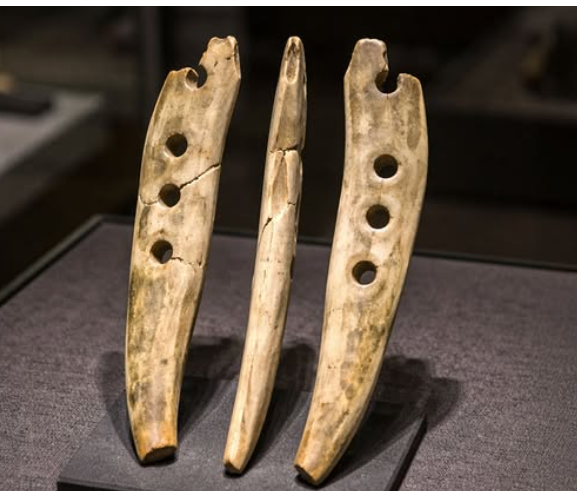
September 2026 Hohle Fels Cave: Item possibly used for perishable material.
Smithsonian reports possible use for a lochstab, The Lockstab is an ivory baton with several holes in it, found In Hohle Fels Cave in Germany in 2015.
Archaeologists tend to concentrate on the materials preserved such as stone or bone tools, shells, ochre. What about the material they know must have been used but is not likely to survive, such as rope and twine? Robe and twine would have been crucial and necessary parts of the human tool kit and involved complex behavior taught down generations. It is known that fiber use or leather cordage was used at least 250,000 years ago, based on markings on ancient tools. Neanderthal twine was reported in Nature in 2020.
Originally published in a German journal in 2016, Archäologische Ausgrabungen in Baden-Württemberg by Conard, et al, the discoverers of the baton, report that they tested the baton to determine if this was a cordage maker. The success of the test demonstrated it could have been a rope making device. Frequently these kinds of items are treated as shaft straighteners….were they more or have they always been incorrectly identified?

In 2011, Pelagic or deep sea fish was noted at 42,000 Years ago, East Timor
Jerimalai Shelter in East Timor provided evidence of early fish hooks and large Oceanic Pelagic fish such as tuna.
Obtaining large deep sea fish suggests deep ocean sea capable boats, knowledge of sea behavior, weather, and expert knowledge of fish behavior. The tuna seemed to be younger and smaller than adults, which may have been too heavy for these early fisher men to haul into their boats. (Pelagic Fishing at 42,000 years before the Present and the Maritime Skills of Modern [Paleolithic] Humans; Science, 2011, Volume 334, O’Connor et al. )
Did Early Humans Collect Keepsakes 500,000 Years Ago?
“A new Tel Aviv University study suggests that colorful stones, fossils, and ancient tools may have helped early humans preserve personal memories, potentially shaping the evolution of autobiographical memory and our sense of self.” Evolutionary Anthropology, Oct/Nov 2026, Ram et al.
We know modern humans keep souvenirs, colorful items, rocks, natural items of many kinds. How far back does this go? This article from U. of Tel Aviv, suggests that at least 500,000 years ago, humans were collecting things that attracted them. Did these items serve as recall, reminders, memories of past events? Were some of them simply objects of beauty that attracted the eye? How far back do the concept of beauty for its own purpose and attraction to color and shape go? The authors assert the curated items go beyond simple utility. ” By preserving these old colourful layers, the recycled artifacts may have served as tangible extensions of their source locations and past histories, including with particular individuals, thereby helping to
physically authenticate memories through direct material
engagement.”